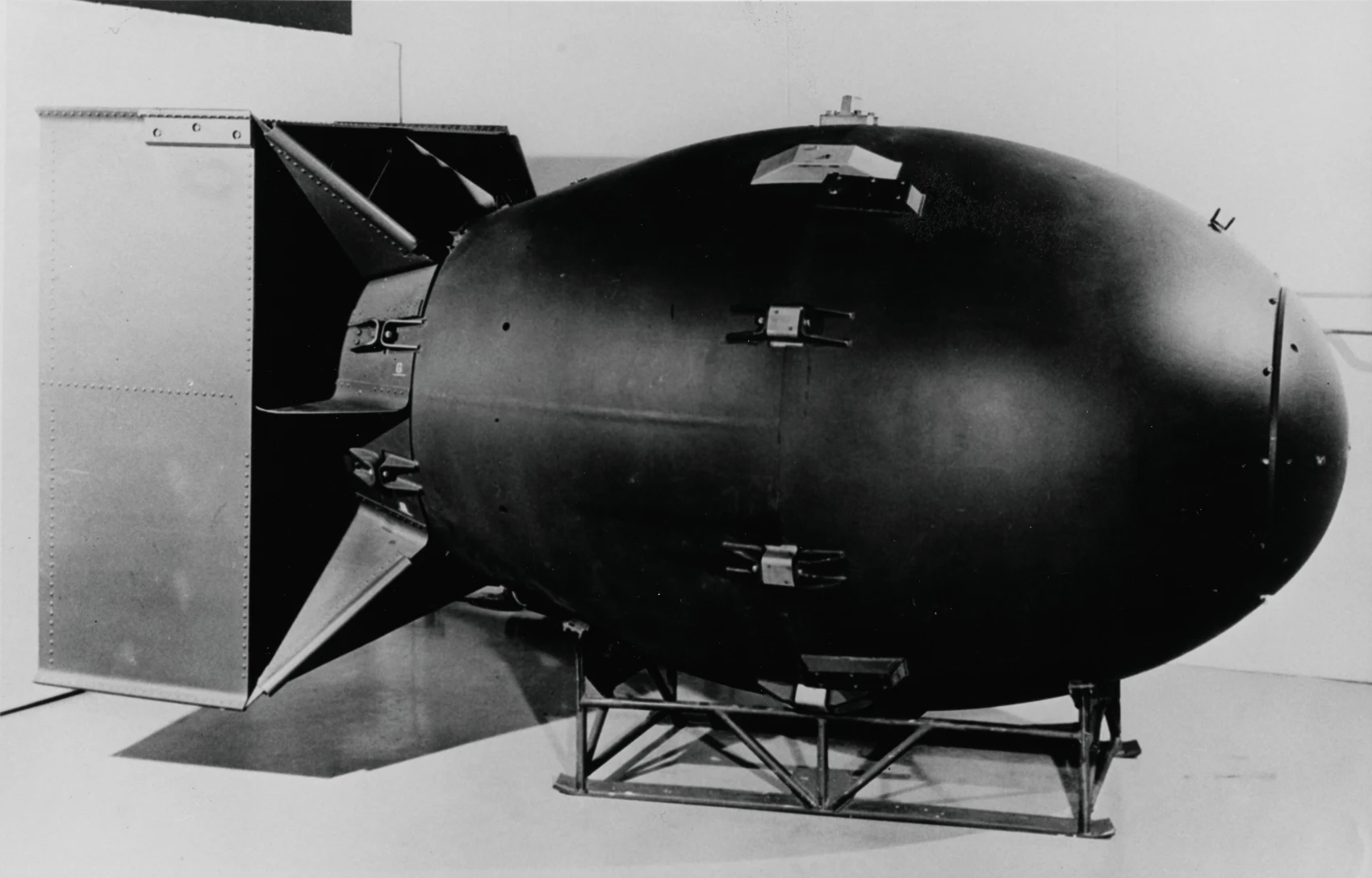

Research and production
The weapon used reactor-produced plutonium from Hanford. Los Alamos developed the weapon while the industrial plants were scaling up production. Fat Man used the project’s plutonium implosion design. Trinity tested the same general approach three weeks earlier in New Mexico.
The Science of Fat Man →Explore quantum states, nuclear materials, and the history of the design step by step.
The science of fission
When a fissile nucleus absorbs a neutron, it can split into smaller nuclei. The fragments carry kinetic energy, and the reaction releases radiation and additional neutrons. If enough neutrons trigger further fissions, the chain reaction grows. The term supercritical describes a system in which the neutron population increases from one generation to the next.
In a power or production reactor, operators regulate a chain reaction over time. In these weapons, a rapidly growing chain reaction released energy before the device disassembled. That energy heated the surrounding material and air, producing the flash and blast. Ionizing radiation reached people near the explosion and contributed to acute illness and later disease.
From experimental reactor to Hanford
Plutonium-239 can be formed when uranium-238 captures a neutron and the product undergoes radioactive decay. Oak Ridge’s X-10 reactor provided research quantities. Hanford’s B Reactor began producing plutonium for the wartime program in September 1944. Chemical separation recovered plutonium from irradiated material so it could be studied and fabricated at Los Alamos.
Research revealed that reactor-produced plutonium contained isotopes with different spontaneous fission rates. Those extra background neutrons made the originally planned gun-type plutonium design unsuitable. The finding redirected laboratory work toward implosion.
From Los Alamos to Trinity and Tinian
The implosion approach used compression to change the physical conditions in the plutonium so that neutron multiplication could grow rapidly. The scientific challenge was understanding and controlling how materials behaved under a rapidly converging shock. Physicists, chemists, metallurgists, and engineers worked on different parts of the program.
The July 16 Trinity test demonstrated the general plutonium approach later used in Fat Man. The wartime production and field teams then prepared the weapon for the separate Nagasaki mission. Its route from Hanford through Los Alamos and Tinian makes the scale of the undertaking visible.
The mission
The B-29 Bockscar departed Tinian on August 9, 1945. Kokura was the primary target. Obscured visibility led the crew to divert to Nagasaki, where the bomb detonated over Urakami. The city records the time as 11:02 a.m. local time. The U.S. National Park Service mission chronology identifies its time convention, which is important when comparing it with Japanese accounts.
The people below
At 11:02 a.m., the bomb detonated over Urakami. Teachers and children, postal workers, medical staff, and families in their homes were among the people below. The valley held homes and places of worship as well as wartime industry. Korean victims included people brought to Japan for wartime labor.
Sumiteru Taniguchi was delivering mail by bicycle when he was severely burned. Sachiko Yasui was six and later wrote about the losses her family lived through. Dr. Takashi Nagai helped organize relief despite his own injuries and his wife Midori’s death.
The devastating impact
The heat burned people outdoors and started fires. The shock wave destroyed homes and damaged Urakami Cathedral. The hills shaped where damage spread. Survivors had to seek care through shattered streets while injured medical staff treated others.
A postwar survey cited by Nagasaki estimated approximately 74,000 deaths by the end of 1945. Some people died after the day itself from burns, injuries, or acute radiation illness. Others lived for decades with the effects of injuries, illness, and bereavement.
- Nagasaki · The day of the bombing
- Nagasaki · Survivor stories
- Nagasaki · Surviving across decades
- National Park Service · Atomic weapons
- National Park Service · Flight chronology